

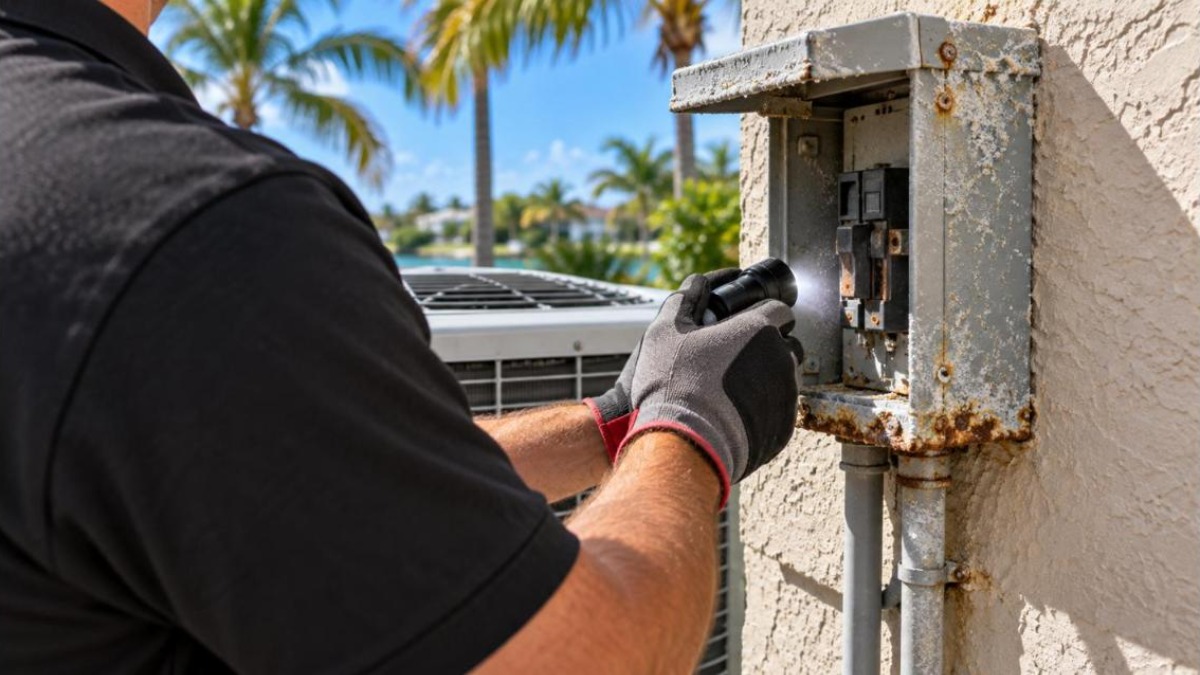
If you live on Estero Island, or anywhere the Gulf breeze reaches your house, the outside of your electrical system ages faster than the inside of your home does. Salt settles on the meter can, the panel cover, the AC disconnect and every screw holding them together. Add our humidity and you get the rust you can see, plus the kind you can’t: corrosion on the lugs and breaker connections behind the cover.
This guide covers what electrical panel corrosion from salt air looks like, why your insurance company cares about it, and how to tell when cleaning it up is enough and when the panel has to go. It’s written with Fort Myers Beach in mind (the same advice fits canal homes in Cape Coral and the bay side of Bonita Springs).
Where salt air corrosion shows up first
Start with a slow walk around the outside of the house. The usual trouble spots:
- The meter can, especially rust streaks along the bottom seam and around the ring that holds the meter.
- An outdoor panel or main disconnect with blistered paint, rusted hinges or a cover screw that won’t turn.
- The AC disconnect and the flexible whip running to the condenser. These sit low, catch sprinkler water and tend to rot before anything else on the wall.
- Pool and spa equipment panels.
Inside the panel is where it counts, but that’s a job for an electrician with the power off. What we look for in there is white or green crust on the lugs where the big service wires land, discolored breaker terminals, pitting on the bus bar and breakers that feel loose when they’re seated. Corroded connections add resistance. Resistance makes heat, and heat is how a slow corrosion problem turns into scorched breakers, a burning plastic smell or a fire. By the time you smell it, the problem has been building for a while.
One thing worth saying plainly: please don’t pull the inner cover (the dead front) to look for yourself. The service lugs stay energized even with the main breaker off.
Why your insurer cares about panel corrosion
If your home is older and you’ve had a 4 point inspection, the electrical section asked the inspector to check off hazards. On Citizens Property Insurance’s sample 4 point form, corrosion is one of those boxes, listed right next to double taps, scorching and improper grounding. A checked box can mean the insurer wants the repair done before it writes or renews the policy, and that often comes with a deadline.
The meter can is its own question. In FPL territory the meter belongs to FPL, but the enclosure it plugs into belongs to the homeowner (the Florida Public Service Commission settled that back in 1987). So if FPL flags a rusted or damaged meter can at your house, fixing it is on you, and the repair has to be done by a licensed electrician.
After a storm surge, the rules change
Hurricane Ian’s surge in September 2022 pushed Gulf water into ground level garages and utility rooms on the island. Salt water is a different animal from rain. The Electrical Safety Foundation International says ocean water and salt spray are especially damaging because the residue left behind is both corrosive and conductive. ESFI puts molded case circuit breakers and GFCI and AFCI devices on its list of equipment that should be replaced after water exposure, not dried out and reused. Panelboards themselves may be reconditioned, but only after a qualified electrician evaluates them.
Our take: if salt water got inside the panel, plan on new breakers at a minimum, and on an older panel, plan on a replacement. Either way, don’t turn the main back on until it’s been checked.
Permits on the island run through the Town of Fort Myers Beach building services, which takes applications online through its iWorQ portal. The Town also still enforces FEMA’s 50% rule during plan review because so much of the island sits in the flood zone. A panel replacement on its own is a small piece of most home values, but if it’s part of a bigger remodel, talk to your contractor early about how the total project cost adds up.
Clean it, protect it or replace it
Light surface rust on an outdoor cover is mostly cosmetic. A wire brush, a coat of primer and exterior metal paint will buy you years. Point the sprinkler heads away from the wall while you’re at it, since constant wet salt residue is what eats these boxes alive.
Corrosion on the breakers or lugs is a repair call. That usually means replacing the affected breakers, cleaning or replacing the lugs and retightening every connection to the manufacturer’s torque spec.
And some panels are just done. A rusted back wall on the enclosure, a pitted bus bar or breakers that won’t seat firmly anymore all point to replacement. A like for like panel swap typically runs $1,500 to $3,000 in our area; our panel upgrade cost guide breaks down what moves that number. If your panel is the original one from an older beach cottage and it’s rusting through at the back, we’d skip the repair and price a new one.
For outdoor boxes within sight of the water, ask about the enclosure rating. A standard NEMA 3R box is painted steel built to shed rain. NEMA 4X adds corrosion resistance and is usually stainless steel or fiberglass. It costs more, so it makes the most sense on disconnects and pool equipment that take the brunt of the salt spray.
How often to check for electrical panel corrosion near the beach
Once a year, walk the outside equipment and look for the rust spots above. Do it again after any named storm, even one that only brought wind. And if you’ve never had the inside of the panel looked at, a panel inspection or upgrade visit is a good place to start.
Questions we hear about salt air and electrical panels
Can I spray a corrosion inhibitor inside my panel?
Leave the inside to an electrician. Sprays can leave residue on live parts and won’t fix a connection that’s already corroded. Outside surfaces like the cover and hinges are fair game for paint.
My meter can is rusting. Will FPL replace it?
No. FPL owns the meter, but the homeowner owns the meter can. A licensed electrician has to repair or replace it.
Will corrosion fail my 4 point inspection?
Corrosion is one of the hazard boxes on Citizens’ sample 4 point form. If the inspector checks it, expect the insurer to ask for a repair or replacement before it will cover the home.
Do I need a permit to replace a panel on Fort Myers Beach?
Yes. On the island, the permit goes through the Town of Fort Myers Beach building services instead of Lee County. Your electrical contractor pulls it and schedules the inspection.
Get your panel checked on Fort Myers Beach
Southwest Florida Electric is a family owned electrical contractor based in Fort Myers since 2010, Florida license EC13004490. We work on panels, meter cans and outdoor disconnects across Lee, Collier and Charlotte counties, including Fort Myers Beach. Call 239.745.5020 or send us a note through the contact page.