Peak Hurricane Season Generator Checklist for Southwest Florida (2026)

August and September are when Southwest Florida’s hurricane season stops being theoretical. If you own a standby generator, the worst possible time to find out it won’t start is the night the cone shifts. Run this checklist now — most of it takes twenty minutes, and the items you can’t do yourself are exactly what a service visit is for.

The 20-Minute Owner Checklist

  • Watch a self-test run — most units exercise weekly. Be outside next time it fires. Listen for rough running, hunting, or a test that doesn’t happen at all.
  • Check the controller — green light, no error codes, correct date and time. A flashing red light in August is a five-alarm to-do item.
  • Check fuel — LP tank at 30%? A multi-day outage will drain it. Top off now; delivery trucks get scarce the week after a storm.
  • Look at the battery date — standby batteries in Florida heat last 2–3 years. Older than that? Replace it before it decides for you.
  • Clear the airflow — landscaping grows into clearances all summer. The unit needs breathing room on all sides, and debris around it is projectile inventory anyway.
  • Find your manual transfer procedure — if the automatic transfer fails, do you know what to do? Print it, laminate it, tape it inside the garage.

What a Pre-Storm Service Visit Covers

Oil and filter (an extended run on old oil is how engines die mid-outage), spark plugs, coolant on liquid-cooled units, a battery load test — not just a voltage glance — fuel pressure and regulator check, transfer switch exercise under load, and controller firmware and error history. If the unit hasn’t been serviced in over a year, or it ran hard in a previous outage and hasn’t been touched since, it’s due. Our generator repair and maintenance team does these all season.

Portable Owners: Your Checklist Is Shorter but Sharper

Fresh fuel with stabilizer (last year’s gas is this year’s no-start), a test run under load monthly through season, and — non-negotiable — a proper interlock or transfer switch instead of any cord arrangement into the panel. If you’re still weighing which type of generator fits your household, our portable vs. whole-house comparison lays it out.

The Timing Problem

Every year, the same curve: quiet June, busy August, and a two-week service backlog the moment a storm gets named. The people who call in early August get slots. The people who call when the track map turns toward Lee County get a waitlist. If your unit needs attention, this is the week to book it — call 239-372-9426 or use the contact form.
Are Whole-House Surge Protectors Worth It in Florida? (Lightning Capital Math)

Southwest Florida is the lightning capital of the United States — Lee and Collier counties sit in the most strike-dense corridor in the country. So when people ask whether a whole-house surge protector is worth it here, the honest answer is: this is the one place where the question answers itself. But let’s do the math anyway.

What It Is and What It Isn’t

A whole-house surge protective device (SPD) mounts at your electrical panel and clamps voltage spikes before they reach your circuits. It protects everything hardwired — AC compressor, water heater, oven, garage opener, pool equipment — the stuff a power strip can never reach. It is not a lightning rod: a direct strike to your roof is a different (and rarer) problem. What it handles is the far more common event — surges arriving through the utility lines from strikes blocks away, plus the small internal surges your own appliances generate daily.

The Math

Installed, a quality whole-house SPD typically runs $300 to $700 in this area. Now price the other side: an AC condenser control board, a variable-speed pool pump, induction cooktop electronics, or the inverter in a new fridge — any one failure costs more than the SPD. The average Florida home now has more voltage-sensitive electronics hardwired into it than a 1990s office building.

Layered Protection Is the Real Strategy

  • Layer 1: panel SPD — clamps the big incoming events
  • Layer 2: point-of-use strips — quality surge strips at the TV, computers, and network gear catch what gets through
  • Layer 3: unplug during direct storms — free, and still the only 100% guarantee for a device

Surge Protector Questions We Hear Most

Will it survive a strike, or is it one-and-done?
SPDs sacrifice themselves in stages. Quality units have indicator lights showing protection status — after a major event, check the light. Some events use up the device; that’s it doing its job. Most units carry connected-equipment warranties.

Does homeowners insurance care?
Some Florida carriers offer credits for surge protection, and after-the-fact claims for surge-destroyed AC systems are a classic denial battleground. Preventing the claim beats litigating it.

Can I install one myself?
It mounts inside or beside the main panel and connects to a dedicated breaker — this is licensed-electrician territory, both for safety and because an improperly installed SPD protects nothing.

Installation takes about an hour on a service visit. See the surge protector service page, or pair it with a safety inspection if the panel hasn’t been looked at in years. Call 239-372-9426 or use the contact form.

Portable vs. Whole-House Generator in Florida: The Honest Comparison

Every hurricane season the same debate happens in every Southwest Florida household: spend a couple thousand on a portable generator, or five figures on a whole-house standby? Both answers are right — for different houses. Here’s the honest comparison we give people on the phone.

The Real Difference Isn’t Power. It’s Presence.

A portable makes power. A standby makes decisions. The portable requires you to be home, roll it out, fuel it, run cords or a transfer switch, and babysit it for days. The standby starts itself 10 seconds after FPL drops — whether you’re home, at work, or out of state in July, which is exactly when half of Southwest Florida is.

Where a Portable Wins

  • Price — $500–$2,500 buys a lot of capability, especially with an interlock or manual transfer switch professionally installed (a few hundred dollars more, and the only safe way to feed a panel)
  • Flexibility — it can go to the hunting camp, the job site, or a neighbor’s house
  • Enough for essentials — fridge, fans, phones, some lights, maybe a window AC unit

Where a Standby Wins

  • Whole-house coverage — central AC included, which in a Florida August is the whole argument
  • Nobody has to be home — it exercises itself weekly and transfers automatically
  • No gas cans — it runs on LP or natural gas; no 5 AM fuel-line pilgrimages after a storm
  • Insurance-friendly — the house stays cooled and dehumidified, which is what prevents the mold claim

The Numbers Side by Side

Portable: $500–$2,500 for the unit, plus a professionally installed interlock or transfer switch. Standby: $9,000–$20,000+ installed, all-in — unit, pad, gas, electrical, permits. The full breakdown is in our whole-house generator cost guide.

The Dangerous Middle Ground

What we never want to see: a portable backfed into a panel through a dryer cord. It can kill the lineman working your street and it’s how houses burn down. If you go portable, the interlock kit is not optional — it’s the whole difference between a backup plan and a hazard. We install them constantly and cheaply relative to what they prevent.

Which One Is Right for You?

If you evacuate every storm, travel in summer, have medical equipment, or simply refuse to do another August without AC — you’re a standby household; start at our standby generators page. If you shelter in place, are handy, and mostly want the fridge and fans covered, a portable with a proper interlock is a legitimate answer, and we’ll install the switch. Either way: send a request or call 239-372-9426 and we’ll size it honestly.

House Rewiring Cost in Fort Myers: Full and Partial Rewire Prices (2026)

Nobody wants to rewire a house. People do it because an insurance carrier forced the issue, a 4-point inspection failed, or the wiring itself started announcing problems. Here’s what rewiring actually costs in the Fort Myers area in 2026, when you need a full rewire versus a cheaper fix, and why so many Southwest Florida homes from the 60s and 70s are on borrowed time.

The Short Answer

A full rewire of a typical 3-bed/2-bath single-story home in the Fort Myers area generally runs $8,000 to $15,000+, depending on square footage, attic access, and whether the panel needs replacing at the same time. Partial rewires — one circuit, one addition, one problem area — scale down accordingly and are often quoted flat. Larger homes, two-story layouts, and plaster walls push the top of the range.

What Drives the Number

  • Access — open attic and crawl spaces keep costs down; furred-out block walls and vaulted ceilings raise them
  • Panel condition — if the panel is going too, bundling it saves real money versus two projects (see our panel cost guide)
  • Drywall repair — some openings are unavoidable; who patches and paints affects the total
  • Permits and inspections — rewires are permitted work, always; budget for it and be suspicious of any quote that skips it

Aluminum Wiring: The Southwest Florida Special

Thousands of area homes built between the mid-60s and mid-70s were wired with aluminum branch circuits, and Florida insurers have spent the last decade refusing to renew policies on them. You have three real options: a full copper rewire (the permanent fix), COPALUM or AlumiConn connector remediation at every device (the insurer-accepted middle path, typically a fraction of rewire cost), or shopping for one of the few carriers that still tolerates it (a strategy with a shelf life). We do the first two and can talk you through which makes sense for your house and your policy.

Signs the Wiring Is Actually Failing

Frequent breaker trips across different circuits, outlets that spark or sit loose, flickering that follows appliance use, two-prong outlets everywhere, cloth-insulated wiring in the attic, or that faint fish-smell of overheated insulation. Any one of these is worth an inspection. Several together is how rewires start.

Rewiring Questions We Hear Most

Does insurance ever pay for rewiring?
Rarely for the rewire itself — carriers treat it as maintenance. Where insurance matters is the other direction: rewiring (or remediating aluminum wiring) is often the only way to keep or get coverage on an older home.

Do I have to move out during a rewire?
Usually not. We work room by room and keep power on to the parts of the house we’re not in. Kitchens are the most disruptive stretch, typically a day or two.

Can I rewire in stages?
Yes — by circuit or by area, worst first. It costs somewhat more in total than one project, but it spreads the spend and every stage is permitted and inspected on its own.

For the broader pricing picture, start with our electrician cost guide, or see the electrical wiring service page.

Ready for a straight answer on your house? Call 239-372-9426 or send a request through our contact form.

Emergency Electrician Cost in Fort Myers: After-Hours Pricing Explained (2026)

It’s 10 PM, half the house is dark, and the first question after “is this dangerous?” is “what is this going to cost me?” Fair question. Here’s how emergency electrician pricing actually works in the Fort Myers area in 2026 — what the premium covers, what typical after-hours calls run, and how to tell a fair emergency price from an opportunistic one.

The Short Answer

Expect an after-hours service call to start around $150 to $400 just to get a licensed electrician to your door at night or on a weekend, with the repair itself priced on top — either flat-rate or at an elevated hourly rate, often 1.5x to 2x the standard $85–$150/hr daytime range. A straightforward emergency fix (a failed breaker, an overheated connection caught early) often lands in the $300–$700 all-in neighborhood. Storm damage involving the mast, meter can, or panel can run well past that because permits and FPL coordination get involved.

Why Emergency Work Costs More

  • Somebody has to be awake for you — a real 24/7 operation staffs nights, weekends, and holidays, and that costs money before a single truck rolls
  • Diagnostic time under pressure — emergencies are found-problem work; nobody’s quoting from a catalog
  • Storm-week demand — after a named storm, every electrician in Lee County is triaging the same flood of calls

What Counts as a Real Emergency

Burning smells, scorch marks, a panel that’s hot to the touch, breakers that won’t hold, flooded outlets, damage to the meter or service mast, or any partial-power situation where lights are surging bright and dim — call now, at any hour. A dead outlet in the guest room or a ceiling fan that quit? Book it for business hours and save yourself the premium; a reputable company will tell you which is which on the phone.

How to Avoid Paying the Premium Twice

The most expensive emergency calls are the ones that were cheap scheduled repairs six months earlier. Breakers that trip under load, warm outlets, and flickering when the AC kicks on are all pre-emergency symptoms — priced at regular rates while they stay small. If your panel is old enough to be on an insurer’s watch list, our panel upgrade cost guide covers what proactive replacement runs.

Emergency Cost Questions We Hear Most

Do you charge just to come out at night?
Every legitimate 24/7 electrician has an after-hours service call fee — in this area typically $150–$400. What matters is that the total price is quoted before work starts, not invented at the door. That’s how we operate.

Is emergency work covered by insurance?
Sometimes — lightning strikes, storm damage, and fires are the common cases. Document everything, keep the invoice, and ask us for the description your adjuster needs. Wear-and-tear failures generally aren’t covered.

Can I just wait until morning?
If it involves heat, smoke, water, or a smell — no. If it’s an inconvenience rather than a hazard, waiting is exactly what we’d advise, and it’ll cost less. Call and describe it; we’ll tell you honestly which bucket you’re in.

When you need someone now, our 24/7 emergency electrician page covers the whole service area. For everyday pricing context, see the full electrician cost guide.

Have an emergency right now? Call 239-372-9426. For anything that can wait, our contact form gets you on the regular schedule.

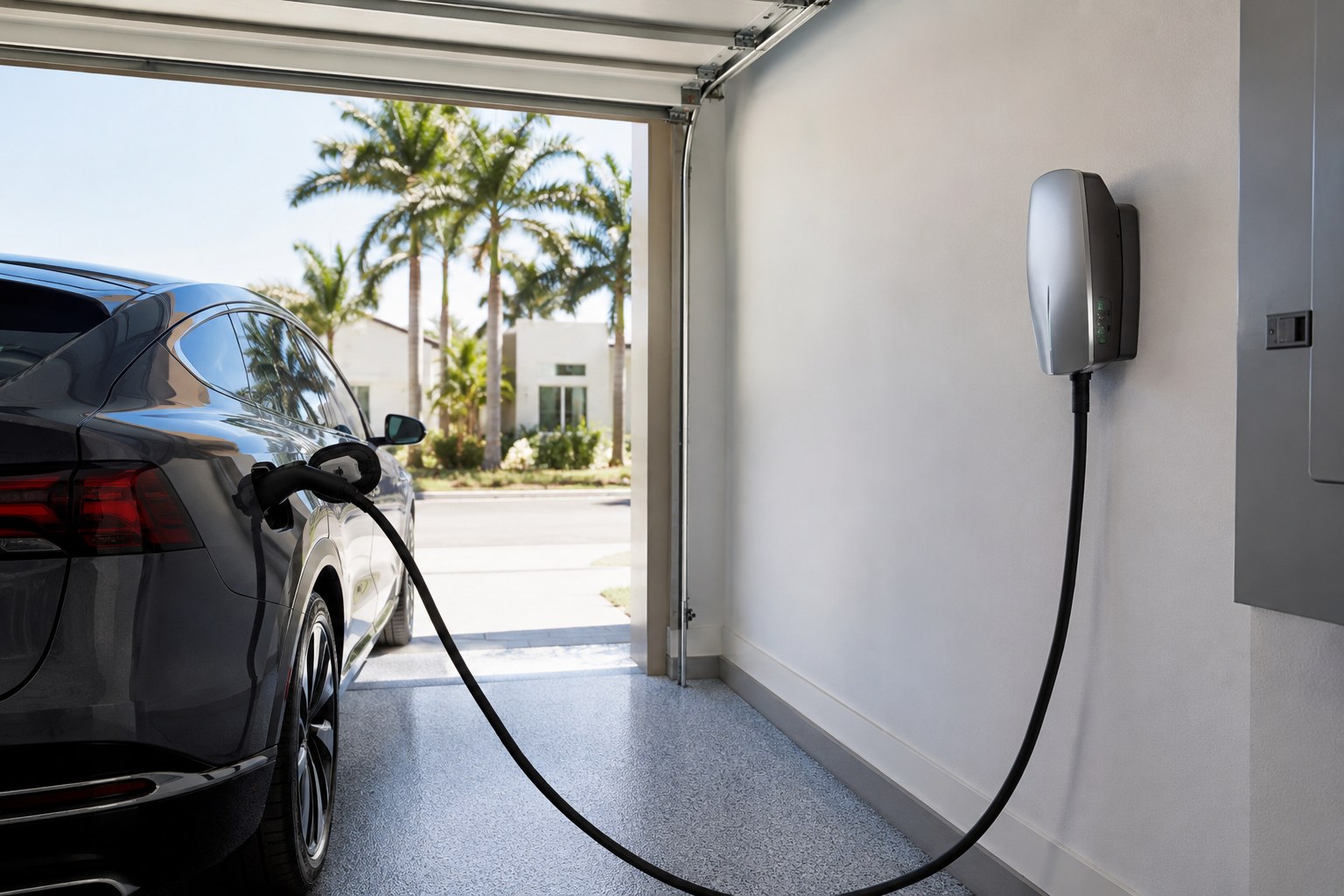
Wall-mounted Level 2 EV charger charging an electric SUV in a Cape Coral garage

EV Charger Installation Cost in Fort Myers (2026)

The car was the big purchase. The charger install shouldn’t be a mystery on top of it. Here’s what Level 2 EV charger installation actually costs in Fort Myers in 2026, what moves the number, and the one expired tax credit some installers are still advertising.

The Short Answer: $450–$1,500+ Installed

That range covers the electrical work: a dedicated 240-volt circuit from your panel to the charger location, the breaker, mounting, connection, permit, and inspection. Where you land in the range comes down to three things:

  • Distance. Panel in the garage? Low end. Panel on the far side of the house with an attic run? Higher.
  • Circuit size. A 60-amp circuit needs heavier wire than a 30-amp one. Faster charging costs a bit more to wire.
  • Conduit and drywall. Exposed garage walls are cheap to work with; finished walls and exterior conduit runs add labor.

Hardware Is Separate

Level 2 units from ChargePoint, Emporia, Wallbox, and Tesla mostly run $300–$700. We install any of them, including chargers you’ve already bought. Tesla owners: our Tesla charger installation page covers Wall Connector specifics.

The Tax Credit Is Gone — Don’t Get Sold On It

The federal 30C home-charger credit expired June 30, 2026. If an installer’s pitch still leans on a 30% federal credit, that tells you how current the rest of their information is.

When a Panel Upgrade Enters the Picture

A Level 2 charger is a major load. If your panel is old, full, or 100-amp, the honest quote might include a panel upgrade ($2,500–$6,000 for 100→200 amp). Nobody loves hearing that — but a load calculation up front beats a nuisance-tripping panel afterward.

EV Charger Cost Questions We Hear Most

How much does it cost to install an EV charger in Fort Myers?
Professional Level 2 installation typically runs $450 to $1,500+ in the Fort Myers area. Short, simple runs from a panel with capacity land at the low end; long runs, conduit work, or tight panels push toward the high end.

Does that include the charger itself?
No — hardware is separate. Most quality Level 2 units run roughly $300 to $700, and Tesla’s Wall Connector is in the same neighborhood. Some buyers use the mobile cord that came with the car plus a $10–$50 outlet-based setup instead.

Is there a tax credit for home EV chargers in 2026?
The federal 30C credit expired June 30, 2026. Unless Congress revives it, plan on paying full freight — and be wary of any installer still advertising the credit.

Will I need a panel upgrade?
Only if your panel lacks capacity. Many Fort Myers homes take a charging circuit with no changes; older 100-amp services often don’t. A 100-to-200-amp upgrade runs $2,500–$6,000 if you need it. A load calculation answers this before anyone spends money.

Can I just plug into a regular outlet?
Yes — that’s Level 1 charging, and it adds only about 3–5 miles of range per hour. Fine for short commutes; painful for anything else. Level 2 charges roughly 6–10 times faster.

We install across the region — see EV charger installation in Fort Myers, Cape Coral, and Naples.

Want a real number for your project? Call 239-372-9426 or use our contact page for a firm quote. Licensed & insured — FL License EC13004490.

How Electric Car “Friendly” is Florida? Tax Credits, Benefits & EV Charging Station Locations

Updated July 2026: The federal 30C tax credit for home EV charger installation expired on June 30, 2026, and the federal EV purchase credits ended September 30, 2025. Some Florida utilities still offer their own EV rebates — check with FPL or LCEC. For current pricing and what an installation involves, see our EV charging station installation page.

We’ve been hearing the buzz about the electric car revolution for years, but America is still a long way from making a switch to charge-only vehicles. Or is it? Continue reading →